Lots Of Little Things Are Getting Done

The last week or so there have been a lot of little things getting done… It’s feeling more and more complete…

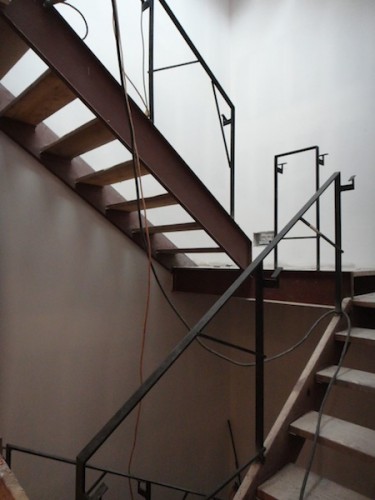
The railings are being installed for our staircase…

stair railings

All the steel will be painted white, and there will be milk white plexi panels mounted on those frames and wood handrails. The railings are a bit shaky because they’re so thin. We’re hoping the plexi and handrails will stiffen things up a bit.

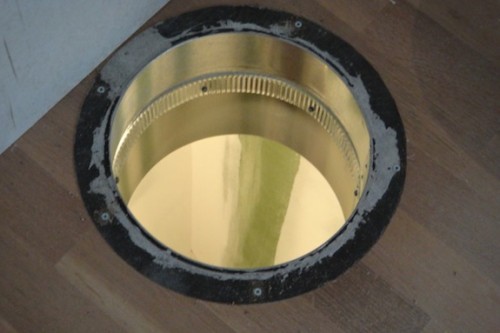
One of my favorite features in the house is the laundry chute from the master bedroom into the laundry room.

laundry chute

It’s funny to find a hole in the floor exciting, but it’s pretty cool (as is the whole concept of a laundry room – I’ve never had in-unit laundry before).

And a bunch of electrical stuff has taken shape…

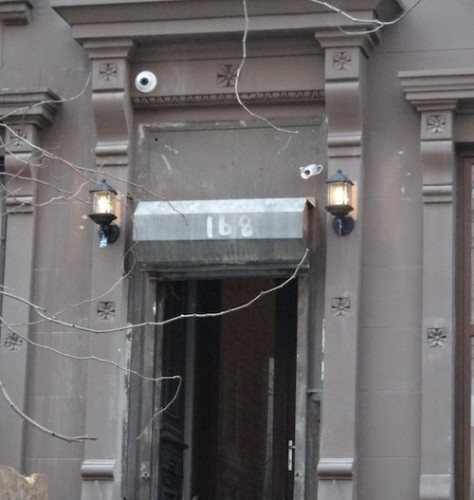
The lights are on the front of the building…

front lights

We’re not sure whether we like those lights or not – they were inexpensive – we’ll change them later if we decide we want something better.

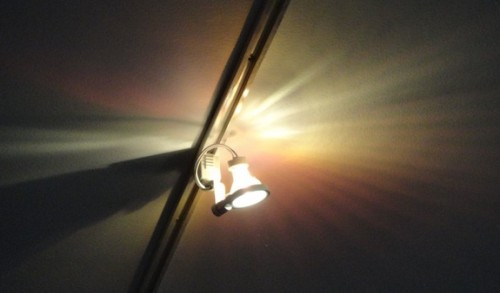
The track lights are mostly in and the lights are being put on the tracks…

track lights

We like how minimal they are – the big part of the lens is just a little bigger than a quarter – so it’s pretty tiny.

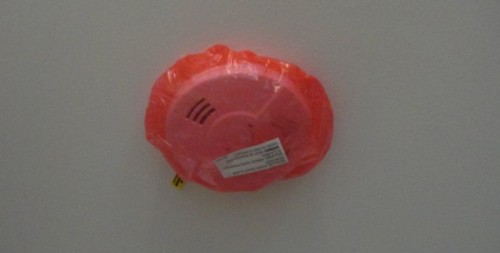
And the smoke detectors have been installed, but the little protective plastic bags sorta defeat the whole point of detecting smoke…

smoke detectors

The thing I’m not looking forward to is that NYC code requires all the smoke detectors to go off when one of them goes off. When Dan burns something on the stove it’s going to be LOUD. But on the good side, they’re all hardwired – so no dead batteries to worry about.

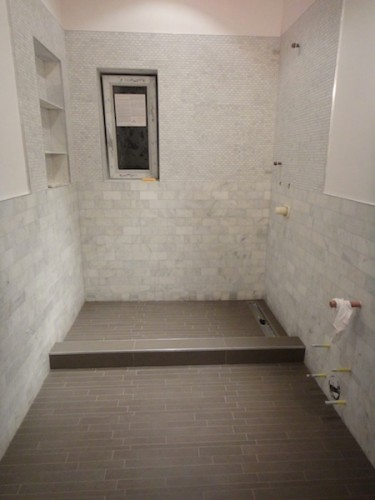
And the last of the bathrooms has been tiled (the master bathroom)…

master bath tiled

That took one of the workers 3 weeks to tile… The guy is slow, but he’s an absolute perfectionist so it’s flawless when you look at it close up. The same guy is now skim coating some of the walls (like the walls in the bathroom above).

Hopefully in the next week some of the plumbing fixtures will start getting installed and there will be a big push on painting and finishing up the floors.

Today we went to Ikea to buy closets, but when we got there we hated them. They’re not nearly as well made as Ikea’s kitchens. The closet solutions at Container Store are about 50% more – so we’re not sure what we’ll do – maybe just have the contractor make what we originally planned.

Problems With DOB Continue

The insane bureaucracy at the Department of Buildings is causing us huge problems, AGAIN. Near the end of every job there are a host of little things that have to be corrected on the filed plans so when the final inspection happens, what the inspector sees matches what’s on the plans. The most critical issue in our case is that the sizing of the gas pipes wasn’t specified in the original plans, and the plumbing inspector won’t sign off on the work until they’re shown. Without his sign off we can’t get our “blue card” and without the blue card we can’t get gas service and without gas service we have no heat. Without heat we can’t really put water throughout the building for fear of frozen pipes. But pipe sizing is just one of many issues that need to be corrected on the plans – there’s a bunch of other stuff – none of which is major.

When we filed for a Post Approval Amendment (PAA) we were told our original plan examiner had been promoted – he’s now part of some centralized watch dog oversight group. The problem is the new plan examiner has to sign off on everything – not just the things that are changing. He found a pretty fundamental flaw with the original filing – the “construction classification”…

Construction Classification:
Existing: 3: NON-FIREPROOF STRUCTURES
Proposed: I-D: 1 HOUR PROTECTED

The problem is 1D with 1 hour fire protection isn’t what we’re doing – that would require all floors/ceilings and significant walls to have a 1 hour fire rating – the job should never have been filed that way. The plans clearly show that only certain parts of the building will have 1 hour fire rating – between the units, around the boiler room and the stairwell in our unit. The architect and expediter got it wrong, I didn’t notice it, and the original plan examiner missed it. But it makes a difference. Apparently construction classification is something FDNY relies on when they go to fight a fire. They don’t send fire fighters in after a certain amount of time unless they know the building will be safe.

The problem compounds itself since certain things that are allowed in fire rated construction aren’t allowed in non-fireproof buildings. For example closets and storage spaces under egress stairs aren’t allowed since a fire could start in the closet. So now we have to go back and pick the best/correct classification, and then see if there’s anything we’ve built that doesn’t comply with that classification. It’s fortunate at this point that we’re “fully sprinklered”, but my worry is that additional sprinkler heads might be required since “fully sprinklered” means different things depending on the situation. For example our power room on the parlor floor is under the stairs. Will it now need to be sprinklered?

The plan examiner made it clear that he wasn’t going to stop with the construction classification. Our appointment wasn’t as long as it needed to be and he had just started in on other items by the time it was over. He pointed to the stairs off the rear deck that go down into the garden and asked aloud if that they were a “permitted obstruction”. Because our rear yard is a couple feet below the level of the basement/ground floor the staircase from the rear deck goes (a couple feet) “more than one story” and that changes things. UGH… For god’s sake – it’s essentially one story – is it really that big of an issue? I’m thinking we may need to create a berm in the back yard that’s level with the basement/ground floor and have the stairs touch down at that point in the yard. IMHO, that’s just bureaucratic insanity, but we gotta do whatever it takes to get things done and signed off…

Unfortunately, you can’t get individual sheets approved. In our case we need the gas riser diagram approved, but all the other things are holding it up. On a larger project you’d file the plumbing as a separate job so you could do narrower PAAs, but that generally isn’t cost effective in project our size. If we could just get that one sheet signed off, things wouldn’t be so dire right now.

The bottom line when we left the plan exam was that, unless we do something drastic, it will probably take months of appointments to get the PAA approved. The new plan examiner is just going to keep finding one thing after another and draw out the process as long as possible – all things that have been signed off on in the past. We don’t have months to complete the project. We need gas, we need heat, and we need to move in so we can stop paying rent and storage fees on top of mortgage.

Our architect has worked on some really large, big budget projects and as a result knows expediters with decades of experience who have a much easier time getting things through DOB. We’re hiring one of those people to do code review and take over expediting. It’s going to cost us pretty big money, but delays and problems could potentially cost us even more. When we have our next plan exam, I’m hoping the plan examiner will know and trust our new expediter and when the plan examiner does bring up issues I hope our new expediter will show he knows the code as well or better than the plan examiner. And if competence and experience aren’t enough, after decades of working with DOB, I’m guessing the new plan examiner will be friends with enough senior people at DOB that the plan examiner will know that just being arbitrarily difficult could backfire on him.

I was thinking ConEd was worse than the DOB. Now I’m back to thinking DOB is worse. I’ll just be happy when things are signed off and we can move in.

Don’t Trash Your Townhouse’s Original Details

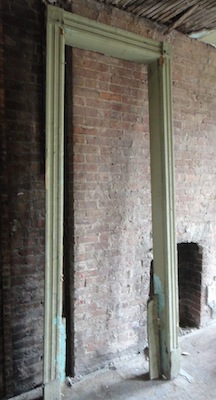
old green door frameFriends are about to start renovations on their South Harlem brownstone. Their place is a total wreck and there aren’t enough original details to warrant a renovation with a traditional aesthetic. Still, there are some original details left and instead of just throwing them out they let Demolition Depot come in and rescue what could be rescued – mostly door and window moldings…
Demolition Depot is giving our friends a small store credit with which they hope to buy an “original” front door. Mind you, to actually use whats being rescued you’d need to strip 100 years of lead-based paint – so there’s a reason why the store credit isn’t all that large.

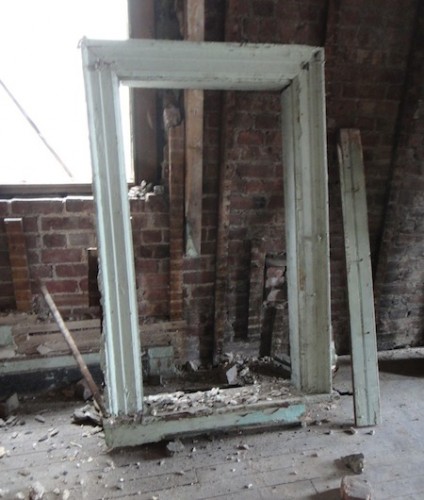
Below is one of the window frames Demolition Depot took out. It’s not all that special (I wonder why they wanted it), but some of the woodwork on the parlor floor was pretty cool and more interesting.

old green window frame

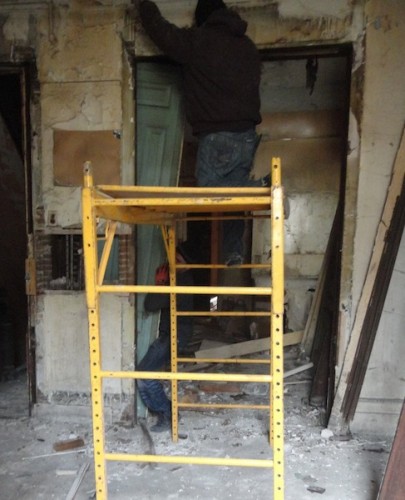
One item Demolition Depot discovered were pocket doors on the parlor floor that our friends didn’t realize were there. I was there when they were taking them out…

pocket doors being removed

Our friends are now thinking they may use those doors as their front doors…

So if you’re doing demolition, don’t just throw everything in a dumpster – if you let a salvage yard rescue what details you have left, it may come in really handy to one of your neighbors. For example we got our front doors from Demolition Depot, and we’ll probably get a bunch of stoop ironwork from them as well.

Our Heating & Cooling Choices

Going into the renovation process we had never chosen a heating and cooling system before. Our tilt-n-turn windows meant we couldn’t have window air conditioners. And when I initially thought through the HVAC choices I wasn’t really in favor of forced air since it tended to be expensive, dusty, and take up a lot of space.

We wound up going with with hot water radiators plus mini-splits. Some of the money we saved going with rads, we spent on expensive European radiators (Runtal). We also didn’t go overboard on a zoned system with lots of thermostats. Instead we opted for pretty simple Danfoss valves. The end result looks like this…

runtal radiator with danfoss valve

The exposed pipes will be painted white when it’s all done. Most of the radiators in the house are two units high – that one is in the rental bedroom wall and shorter than the rest – so to get the same BTUs we have everywhere else we had to go with the model that’s 3 units high.

That’s inherently a pretty low-tech solution – a valve and a radiator. It’s just the radiator looks better than most and the valve is thermostatic – so it’s based on temperature works better than regular radiator valves.

[Incidentally - avoid steam radiators - there's no such thing as a high efficiency steam boiler. To get high efficiency you need hot water radiators, not steam radiators.]

Because there’s a valve on every radiator we sorta get a zoned system where every room is a zone. It won’t work quite as well as a real zoned system with thermostats for every zone, but it also cost a lot less. And if we stay on top of it, it will probably perform about as well as a more sophisticated system.

There will be one thermostat for the heating system. A friend’s post on Facebook turned me on to the Nest thermostat. If you haven’t checked it out, take some time and watch the promo videos on their site – it’s incredibly cool. I can’t wait to get one.

The one “problem” that we’ve realized is the issue of curtains. With radiators under all the windows – if we hang curtains all the way to the floor they’ll cover the radiators…

runtal radiators below windows

That’s a bit of a problem because the tilt-n-turn windows limit our window covering choices. They swing inwards, so putting blinds at the top of the window framing is sorta impossible. We were thinking of doing a lot of curtains, but now worry the radiators won’t work very well when the curtains are pulled.

One area where a forced air system might be better is air exchange. Since the house is well insulated, we may not have enough fresh air entering the house. That is easier to solve with a forced air system – you just incorporate a fresh air intake. But honestly I don’t think we’ll have much of a problem – 2 people in 3,000 sq. ft. shouldn’t be a problem.

We are happy that we have mini-splits and that they’re both heating and cooling. The house is warm enough down to about freezing. It maintains 50+ degrees when it’s in the high 30s outside. That means we probably won’t turn on the boiler until it gets down around freezing. If we just need to take the chill out of the air in a single room (or if our tenant wants it to be warmer than we do) we can use the mini-split.

The mini splits are a bit of an eyesore – we tried to hide them the best we could, but they’re still there hanging on the wall. I don’t think that will bother us too much. To us the visual noise of the mini split unit isn’t any worse than the soffits you often have with forced air systems. If you’re the type who doesn’t want to see a mini-split hanging on your wall there’s always the concealed models you can tuck inside a closet. Those have the advantage of being able to cool/heat two rooms (like a bedroom and an en-suite bathroom) – but the concealed models aren’t quite as efficient due to the ductwork.

One other thing to mention is that we have radiators at each end of the house, and since the bathrooms are in the center of the house we were worried they could get a little cold. We were worried they could get a bit cold, so we put under floor heating pads in each bathroom with programmable thermostats. It’s not very efficient heat, but it won’t be used all that often – so it should be fine.

UPDATE:

Some of the comments asked how the radiator piping was configured. Here’s a diagram to explain how it’s been done…

radiator heating diagram

The model numbers are Runtal unless except where they say Slant/Fin. Since we have exposed brick on one side, both pipes are actually on the same side of the building – right next to each other. There are also valves to bleed air from the system in key locations (such as at the top of each riser). Notice that each radiator / loop has a Danfoss valve on it, so we can (nearly) turn off the radiator in rooms and the other radiators will get more flow.

Bulkhead Is Giving Great Winter Light

Things are gradually taking shape – the staircase has been primed, so it’s pretty close to it’s final color. The steel needs to be painted, and the side panels need to be put in, but we’re starting to get a sense for the light that the bulkhead brings into the house. We opted for big windows in a bulkhead rather than the more traditional skylight because it should give more light in the winter and less in the summer.

Here’s a picture looking up, showing the bulkhead windows…

light from bulkhead windows

On a sunny winter day the light is really bright right at the top. On the opposite wall there’s the clerestory window into Dan’s “gallery” / “clean studio”…

bulkhead casting light on clerestory windows

It looks really dark below that flight of stairs, but actually it really isn’t… It’s just a bit of a photographic trick since the direct light is so bright it makes other areas look dark by comparison. As you can see below, there’s plenty of natural light one flight down where there’s a clerestory window into the den / TV room on our master bedroom floor…

stairs from 3rd to 4th floors

It’s only below that point that the light bulbs are brighter than natural daylight. [All of those pictures were taken within a few minutes of each other.]

Of course, the light will change when we put in the plexi panels on the sides of the stairs. We’ll either do a milk-white plexi or a frosted plexi – either one will block a lot of the direct light and make the light that gets through more diffuse.

I gotta say, I really like the whole clerestory-over-a-closet detail in the den. I wouldn’t want it everywhere, but it’s interesting. Here’s a couple pictures…

den clerestory window and down hallway

den clerestory window

Those pictures were taken a different day (the stairwell isn’t primed yet in those pictures) – and it was later in the day when there was less light coming down the stairwell. In person the clerestory window has more depth to it, which you can only sorta get from the pictures.

One thing we noticed a few months ago is that on summer mornings, when sun hits the front of the house, light goes from the den into the stairwell – opposite of what we expected. But we’ll need to wait a few months to see that happen again :)

And, in case you’re wondering, we’ll be putting wire glass (fire rated) fixed-pane windows into those openings.

Today they’re putting the first of two coats of ceiling white on the ceilings. And they’ve started tiling the bathrooms – I’ll do a post on that soon…